

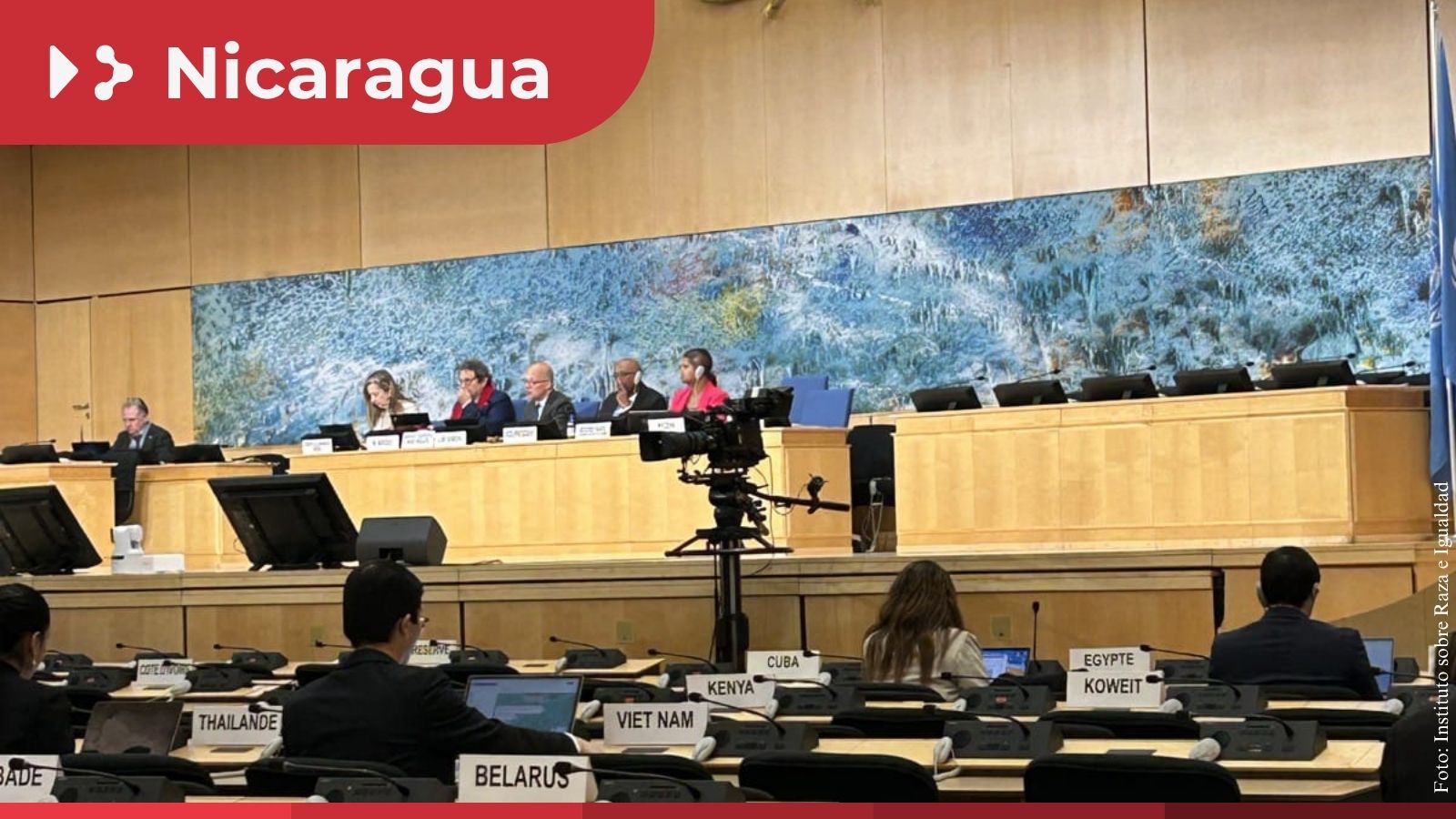
March 17, 2026— The Group of Human Rights Experts on Nicaragua (GHREN) presented this Monday, before the 61st Session of the Human Rights Council, its Annual Report examining the human rights situation in Nicaragua, providing new insights to analyze the continuity, gender dimension, and escalation of political repression, which is increasingly taking on a transnational character.
Just days before another anniversary of the violent repression of the protests in April 2018, the organizations that make up the 46/2 Collective recognize the important documentation work that the Group of Experts has carried out over these years. Their reports, the product of rigorous and systematic work, reaffirm and lend greater legitimacy to the complaints that human rights organizations have made throughout this time, while also bringing to light the voices silenced during these eight years of sustained crisis.
The new report delves into the main patterns of transnational human rights violations, such as surveillance, threats, harassment, and physical violence; the abuse of international control and cooperation mechanisms; the arbitrary deprivation of nationality; the confiscation of property; and reprisals against family members who remain in the country. It also analyzes the gender dimension of transnational repression and the transnational intelligence and surveillance architecture that enables the State to monitor and persecute Nicaraguans in exile.
A novel aspect of the Report is the investigative progress regarding the financing of the State’s repressive apparatus and its links to corrupt practices. The Report explains various methods used since 2018 that involve the misuse and diversion of public funds to finance repression and human rights violations and achieve greater social control. At the same time, it identifies the direct individual and institutional perpetrators of these acts of corruption.
In its conclusions, the GHREN issues a new call to the international communityregarding its responsibility to act in light of the worsening situation and the Nicaraguan State’s refusal to cooperate with the United Nations. In this regard, it warns that given the magnitude and duration of the violations, the longer action is delayed, the heavier the burden will be to restore rights, democratic institutions, and the rule of law.
The Group also urges the State of Nicaragua to adopt effective and unconditional measures to achieve a peaceful and concerted transition in accordance with its international human rights obligations. The report recommends that the State take a series of measures leading to the cessation of human rights violations, an end to political repression, and an end to impunity. The GRHEN also reiterated general recommendations addressed to the that it has previously put forward, highlighting, among others, the following key recommendations: Conduct investigations and criminal prosecutions on the basis of extraterritorial jurisdiction, including universal jurisdiction; impose targeted sanctions and other legal measures on individuals, entities, and institutions identified by the Group as responsible for or complicit in violations, abuses, and crimes; and demand that Nicaragua be held accountable before the International Court of Justice for violating the Convention on the Reduction of Statelessness and the Convention against Torture.
During the interactive dialogue, more than a dozen diplomatic delegations addressed the Council regarding the GHREN report and the Nicaraguan crisis. The European Union delegation in Geneva thanked GHREN for its report and reiterated its full support for its mandate, expressing alarm at the findings regarding the gender dimension and the transnational nature of the repression, and further condemning the abusive use of INTERPOL alerts. The delegation reiterated its call for the restoration of the rule of law in Nicaragua and full compliance with international human rights obligations.
For its part, the United Kingdom delegation also expressed deep concern over the continuing deterioration of human rights in Nicaragua, noting that the fact that such violations may constitute crimes against humanity underscores the need for international scrutiny. Canada, on behalf of the countries comprising the Core Group—which follows up on the resolution that established the GHREN mandate—called on the Council to monitor the situation and support accountability efforts, while Uruguay rejected the policy of arbitrary deprivation of nationality as a tool of repression.
Civil society organizations also participated in the interactive dialogue that followed the presentation of the report. In their statements, they welcomed the report, denounced the closure of 83 more organizations in 2025, and persecution of women defenders, including exile and denationalization, and denounced state violence that transcends borders, as well as the dispossession and usurpation of the territories of indigenous and Afro-descendant peoples, whose right to free, prior, and informed consent has been violated through the granting of mining concessions to foreign companies. Proof of life was demanded for Brooklyn Rivera and all persons in situations of enforced disappearance, such as retired military officer Carlos Brenes, whose daughter also participated in the dialogue and reminded the regime that the world is watching them and documenting evidence of their abuses.
In several statements from civil society, the release was demanded of all those in prison for political reasons—at least 46 people, including women, older adults, and 8 Indigenous forest rangers. From the 46/2 Collective, we reaffirm our commitment to peaceful methods that respect international law. We therefore join the Group’s call for the international community to sustain its work of scrutiny and monitoring and to engage in accountability processes, based on the information provided by the Group regarding serious human rights violations and those responsible for them. Likewise, we urge all Council member states to protect exiled individuals, in particular those who continue human rights defense work while facing the risks of transnational repression.,
—————————–
The 46/2 Collective is a coalition of 21 international, regional, and Nicaraguan human rights organizations that regularly reports to the international community on the Nicaraguan regime’s failure to fulfill its international human rights obligations. Listed below are the member organizations of the Collective that have decided to publicly endorse this statement:
Centro por la Justicia y el Derecho Internacional (CEJIL)
Colectivo de Derechos Humanos Nicaragua Nunca Más
Federación Internacional por los Derechos Humanos (FIDH)
Fundación Sin Límites
Iniciativa Mesoamericana de Mujeres Defensoras de Derechos Humanos. (IM-Defensoras)
Instituto sobre Raza, Igualdad y Derechos Humanos (Raza e Igualdad)
International Service for Human Rights (ISHR)
Movimiento Autónomo de Mujeres (MAM)
Peace Brigades International (PBI)
Unidad de Defensa Jurídica (UDJ)
Urnas Abiertas (UA)