


Washington D.C., February 8th, 2017.- The Center for Justice and International Law (CEJIL) condemns the recent executive orders signed by President Donald Trump, for going against the United States’ obligations under international law. Their implementation could worsen a humanitarian crisis and exacerbate human rights violations affecting migrants, refugees and asylum seekers, who inhabit and transit through the American continent.
Known as “Border Security and Immigration Enforcement Enhancements” and “Enhancing Public Safety in the Interior of the United States”, the executive orders signed on January 25th, 2017 seek to toughen immigration policies by building a wall on the U.S.-México border, and increasing the number of border patrol and immigration agents as well as detention centers. Among other points, these orders also seek to place asylum seekers under detention while their cases are presented and accelerate deportation proceedings.
Then, a third order was signed on January 27th titled: “Protecting the Nation from Terrorist Attacks By Foreign Nationals.” Among other measures, the order paralyzed the entry of people from Iraq, Iran, Libya, Syria, Sudan, Somalia and Yemen for 90 days; suspended the entry of refugees from Syria indefinitely and froze the entry of any Person seeking asylum or refugee status, for an initial period of 120 days.
Under this latter directive, an alarming crisis arose within the country’s international airports as immigration and customs agents detained and, in several instances, deported refugees and asylum seekers from the seven nationalities of interest, as well as visa holders and legal residents.
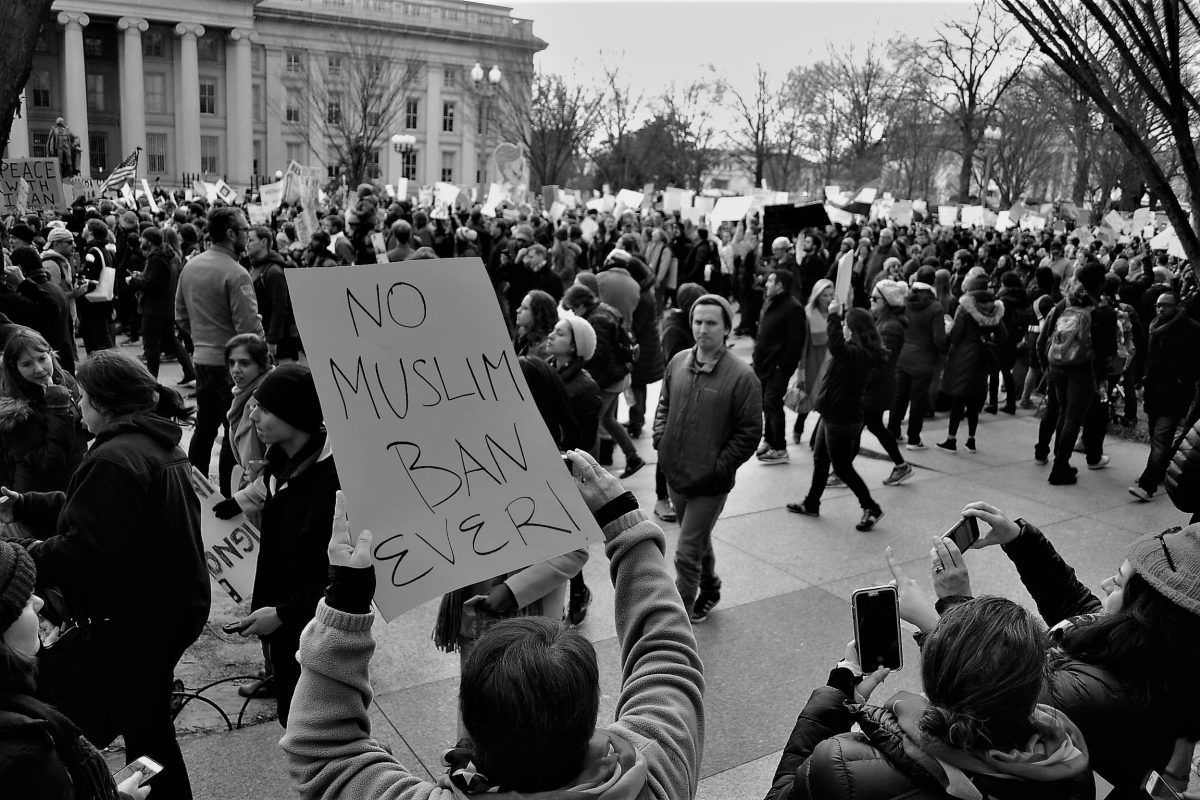
These executive orders subsequently generated a massive outpouring of condemnation and public mobilization within and outside the United States. Likewise, the orders led to the initiation of judicial proceedings to challenge the executive orders. On February 3, a federal judge in Seattle temporarily halted the application of the January 27th order. Three other states have filed lawsuits against that same order. Thus far, however, the presidency has announced that it will continue its fight to implement them.
Within this context, CEJIL raises its voice along with thousands of others to demand an immediate repeal of these three orders, which go against the most basic principles of human rights.
First, by restricting the enjoyment of rights in a way that does not conform to a democratic society, these decisions violate the principle of non-discrimination on grounds of nationality. Additionally, the rules have a discriminatory impact based on the majority religion of the seven countries identified.
Second, these executive orders raise serious concerns about the willingness of the executive branch of the United States to comply with its international obligations regarding the right to individuals to seek refuge and asylum, and to respect the rights of all migrants. We would like to point out that the State must apply the standards of international law by guaranteeing due process, the principle of non-refoulement, and non-discrimination when faced with requests of people who have left their countries of origin by persecution, due to their race, religion, and nationality, membership of a particular social group or political opinion.
Third, detention should always be a measure of last resort. In this regard, both the arrest at airports of people coming in from the seven countries mentioned as well as the detention of asylum seekers while their cases are resolved could lead to violations of their rights to due process and judicial guarantees. The Inter-American Commission on Human Rights and the Inter-American Court of Human Rights have issued numerous recommendations and detailed rulings on the detention and due process of migrants. Each time, both institutions have clearly state that detention is an exceptional measure of last resort, to be used within limited timeframe. Moreover, detention should not be used as a deterrent to the prevention of migration or applied indefinitely and in situations involving children and their families.
CEJIL has represented migrants, refugees and stateless persons from all over the continent before the Inter-American System of Human Rights. We are therefore deeply concerned about the discriminatory nature of these decrees and their effects on the migratory crisis and human rights in the Americas. The United States must immediately repeal these executive orders and promote processes that respect human dignity and guarantee the integrity, life and safety of migrants, refugees and asylum seekers, in compliance with their international obligations.